Key Insights
- Most partnership teams can measure activity, but struggle to measure revenue impact.
- Revenue attribution remains one of the biggest barriers to proving partnership ROI.
- Without a benchmark, it's difficult to know whether a partner program is performing to its potential.
- High-performing programs focus on the right partners, strong enablement, and clear revenue accountability.
- Understanding your partnership revenue gap is the first step to uncovering missed growth opportunities - find out in minutes with Hockey Stick’s Revenue Gap Tool
Most Partnership Programs Look Active. But Are They Actually Delivering Revenue?
Partnerships have become one of the most talked-about growth levers in B2B SaaS.
Boards are asking about them. CROs are investing in them. CEOs are expecting them to contribute more meaningfully to growth.
Yet despite all the activity, many companies still struggle to answer a surprisingly simple question:
What should our partnerships actually be contributing to revenue?
That was the central discussion during Hockey Stick Advisory's recent webinar featuring Jo Gaines (Asana), Basem Emera (Pay.com.au), and Hockey Stick founder Bryan Williams.
The conversation revealed a common challenge facing partnership leaders today: most organisations can measure activity, but very few can confidently measure opportunity.
The Problem: Activity Is Easy to Measure. Revenue Is Not.
Many partnership programs appear healthy on the surface.
Partners are signed.
Campaigns are running.
Referrals are coming in.
But when leadership teams ask about commercial impact, the answers become less clear.
As Bryan Williams explained during the session:
"There's often a lot of ad hoc, reactive opportunities. There's a lot of social media posts, events, conferences, all this activity. But the missing gap is the revenue line of sight."
This creates a dangerous situation.
Partnership teams remain busy, but leadership struggles to understand:
- What partnerships should be contributing
- Whether the program is performing well
- Where additional investment should be made
- What revenue opportunity is being missed
Without a benchmark, success becomes subjective.
Why Revenue Attribution Breaks Down
One of the key themes discussed during the webinar was attribution.
According to Jo Gaines, one of the biggest reasons partnership programs struggle to prove ROI is a lack of visibility.
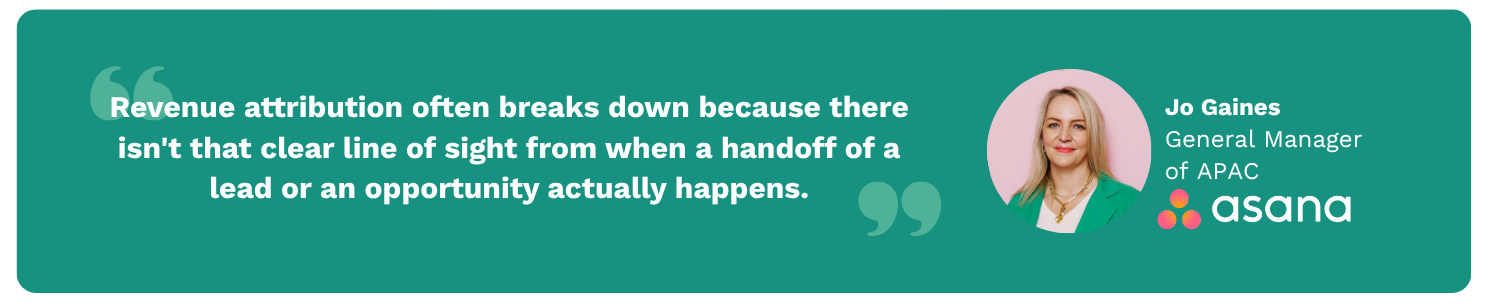
When partners, sales teams, customer success teams, and marketing teams all influence a deal, measuring contribution becomes increasingly complex.
As a result, many organisations default to tracking activity metrics rather than revenue metrics.
The consequence?
Partnerships are often undervalued or underinvested in
The Revenue Gap Most Companies Never Measure
Over the last four years, Hockey Stick Advisory has worked with more than 75 B2B technology companies across APAC.
One observation has remained remarkably consistent:
Most companies significantly underestimate their partnership revenue opportunity.
The challenge isn't that partnerships aren't working.
It's that organisations have no benchmark for what "good" actually looks like.
As Basem Emera explained during the discussion:
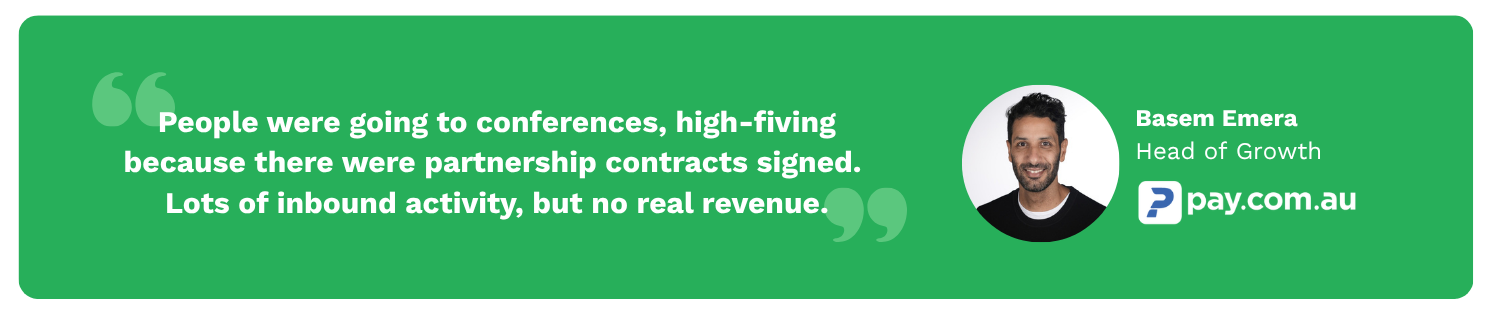
Without a clear benchmark, companies can spend years optimising activity while missing larger revenue opportunities.
Introducing Our Partnerships Revenue Gap Tool
To solve this challenge, we developed Hockey Stick's Partnerships Revenue Gap Tool.
The purpose of the tool is simple:
Provide founders, CROs, revenue leaders, and partnership teams with a data-driven estimate of what their partnerships function could be contributing if fully optimised.
In less than five minutes, the tool analyses:
- Current revenue performance
- Partner ecosystem maturity
- Partner-sourced revenue contribution
- Team structure and investment
- Enablement capability
- Operational infrastructure
The result is a personalised report showing:
- Estimated partnership revenue opportunity
- Revenue gap
- Benchmark comparisons
- Capability constraints
- Priority improvement areas
Rather than asking whether partnerships are working, leaders can begin asking a far more useful question:
How much more should partnerships be contributing?
Why This Matters Heading Into FY27
Many businesses are currently finalising budgets, growth plans, and investment decisions for the next financial year.
This is often when partnership leaders face their toughest challenge:
Justifying additional investment.
Jo Gaines highlighted the importance of having data behind these conversations:
"Data drives the decisions."
Without clear commercial benchmarks, partnerships can easily lose investment to more established growth functions.
With clear benchmarks, partnership leaders gain something far more valuable:
A credible business case.
What High-Performing Programs Do Differently
One of the strongest themes from the webinar was that success rarely comes from simply adding more partners.
Instead, high-performing organisations focus on:
- Better partner selection
- Deeper partner relationships
- Stronger enablement
- Clear revenue attribution
- Executive alignment
- Repeatable co-sell motions
As Jo Gaines explained:
"It's not more partners. It's the right partners."
This shift from volume to value is often where the largest revenue gains occur.
Find Your Partnership Revenue Gap
If you're responsible for growth, partnerships, revenue, or go-to-market strategy, understanding your partnership revenue opportunity is becoming increasingly important.
The organisations seeing the strongest results from partnerships are no longer measuring activity alone.
They're measuring outcomes.
Our Partnerships Revenue Gap Tool gives you a practical starting point.
In less than five minutes, you'll receive a personalised benchmark showing where you stand today, what revenue opportunity exists, and what it will take to close the gap.
Discover:
- Your estimated revenue opportunity
- Your partnership revenue gap
- How you compare to stronger-performing companies
- The highest-impact areas for improvement
Because the most important question isn't whether partnerships matter.
It's whether your program is delivering what it's capable of.